The Spectator
Gallery

President

Tartan Day

Kirking

Family Picnic

Scot Notes

Membership


 Tartan Day at Colonial Heritage Club
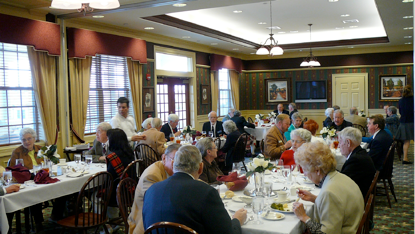
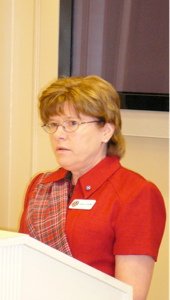
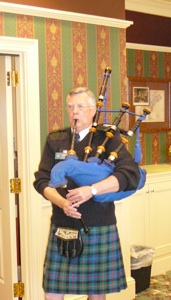
On April 4 the Society celebrated Tartan Day at the Colonial Heritage Club.  This turned out to be another fun gathering with high attendance.  The venue was delightful and the lunch was quite good.  Jamie Griffin, the Society’s first female member, spoke about Tartan Day and the huge contribution that Scots have made to American history, institutions and society.  Lynn Newcomer provided wonderful bagpipe melodies.  There’s nothing like “Scotland the Brave” to fully energize you on a Friday afternoon.  Following is the speech made by Jamie:  

Tartan Day

How many of you have ever been asked if you were Scottish? Obviously, I don’t mean when you were on your way to a St. Andrew’s Society event, dressed in full Scottish attire. As a group, Scots do not have distinct physical characteristics that are recognizable as part of an ethnic group. But if some of you gentlemen wearing kilts were to stop at 7-eleven on your way home today, people would know! Bagpipes and kilts are the two most well known symbols of Scottish culture. Our collective blood boils when we hear kilts referred to as “plaid skirts”; but this is said, not out of spite, but ignorance. This is sad, since we of Scottish descent make up the 8th largest ethnic group in the United States.

While kilts and bagpipes are very much a part of our heritage, there is more to being a Scot than kilts and bagpipes. And Tartan Day is about much more than having lunch and wearing our tartans. This is a day to honor the men and women from Scotland whose contributions to medicine, science, education, religion, literature, the arts and even the history of this country have enriched our lives and made this country great.

It is certainly no exaggeration to say that our country is the most powerful nation of all time, and this is due in large part to Scottish ideas and efforts. In fact, Scottish explorer Prince Henry Sinclair led an expedition which reached North America in 1398, almost a century before Columbus “discovered” America. In 1776, 38% of the men who signed the Declaration of Independence were Scottish. And it was signed in Independence Hall, a building designed by a Scot, Andrew Hamilton. Nine governors of the original 13 states were of Scottish descent. Over the next 232 years, more than 75% of our presidents have been of Scottish descent. And this is in a country where Scots make up less than 5% of the population.

If you have not read the book, The Mark of the Scots, by Duncan A. Bruce, I recommend it to you. It is amazing that a group of people that makes up less than ½% of the world’s population has done so much! Throughout history, Scots have left their mark.  I was surprised to learn that Thomas Jefferson, who drafted the Declaration of Independence, was a descendant of a sister to King Robert I, the Bruce. Others include Patrick Henry, the son of a Scottish born Judge, Thomas Edison, Andrew Carnegie, Washington Irving, and eight generals in the War Between the States. In the more recent past, Billy Graham, Grandma Moses, General Douglas MacArthur and eight of the astronauts who walked on the moon. Duncan Bruce’s book has so many names and lists of accomplishments: I could stand here hours and just give you names.

In 1995, Duncan MacDonald, executive Vice President of The Caledonian Foundation invited Scottish-American groups operating at the national level to a meeting in Sarasota, Florida. The first item of business was to plan a national observance of Tartan Day. Before this time there were many individual observances, but nothing organized nationwide. In 1997, the U.S. Senate proclaimed April 6th to be Tartan Day. The next day, JoAnne Phipps, a Caledonian Foundation member, began working with Senate Majority Leader Trent Lott to prepare a resolution for the Congressional Record. The book, The Mark of the Scots was presented as a resource, and the next year, in 1998, National Tartan Day was permanently recognized by U.S. Senate Resolution 155.

If you have never read U.S. Senate Resolution 155, I encourage you to do so. This well-written document explains that April 6th was chosen because the Declaration of Arbroath, the Scottish Declaration of Independence, was signed on April 6, 1320. More than 450 years later, our forefathers used the language and concepts of the Declaration of Arbroath as the model for our own Declaration of Independence. 
                                                 
Senate Resolution 155 recognizes and honors the major role that Scottish Americans played in the founding of this nation, and states that “Scottish-Americans helped shape this country in its formative years and guide this Nation through its most troubled times.” It “commends the more than 200 organizations throughout the United States that honor Scottish heritage, tradition and culture,” and the fact that these organizations “do not let the great contributions of the Scottish people go unnoticed.” 

After Senate Resolution 155 had been passed, a decision had to be made regarding an appropriate location for the original document. The College of William and Mary was chosen as the ideal place. William and Mary was founded by Scottish Cleric James Blair. It was organized along the lines of a Scottish university, rather than like English schools such as Oxford and Cambridge. Originally, William and Mary only had a president and two teachers, and two of the three were Scots. An alumnus of the college, Thomas Jefferson, said that his mentor, William and Mary Professor William Small, a Scot, “probably fixed the destinies of my life.”

During the presentation ceremony on September 25, 1999, Wayne Retherford, representing the Association of St. Andrew’s Societies in the United States, said, “Tartan Day is a way to start re-educating Americans on the contributions that our forefathers have made. It is fitting that we leave this document here at William and Mary where in so many ways we are close to the beginnings of our nation.”  

Margaret Callander, vice president of the Association of Scottish Games and Festivals, said, “The U.S. has given us an official day to be celebrated on April 6th of each year. It behooves all of us who have a drop or two of Scottish blood to take full advantage of this opportunity to share our Cultural heritage. Let us wear our tartan with pride.” And in the words of Robert Murdoch, national Chairman for Tartan Day, “In closing, let me say I am proud to be involved with persons throughout the country concerning Tartan Day…..and most of all, I am proud to be a Scot.”

As I was doing this research, I stumbled onto a wonderful website that has a Tartan Day Teacher’s Guide.  I contacted the curriculum coordinators of the WJCC and the York school systems to get the word to the school systems about this site, and let them teach it to our children. To learn about Scottish contributions to America is to learn American history. See www.tartanday.org/educators.htm


      Tartan Day at Colonial Heritage


         Jamie  Griffin addresses the Society   Lynn Newcomer energizes the 
                                                                          crowd
          

			                                                                            Next page
http://www.tartanday.org/educators.htmhttp://www.tartanday.org/educators.htmSpectator_-_Spring_3.htmlhttp://livepage.apple.com/shapeimage_1_link_0shapeimage_1_link_1shapeimage_1_link_2
The Spectator
Gallery

President

Tartan Day

Kirking

Family Picnic

Scot Notes

Membership